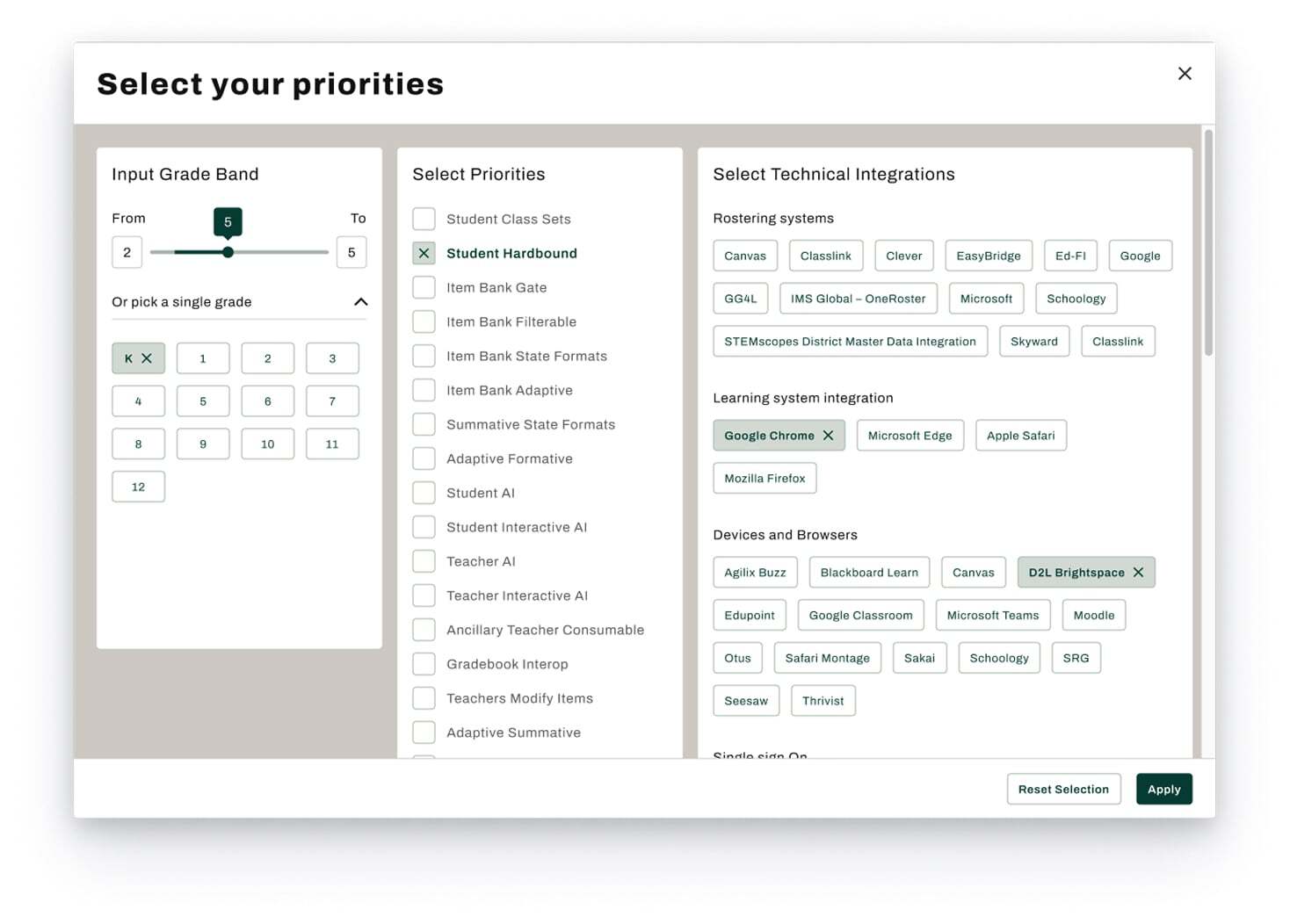
Use the screening tool to compare all state-adopted materials against key district criteria, helping you quickly identify which options are worth moving forward.
Once you identify your options, this step helps your team take a closer look at how well each set of materials aligns with your district’s vision, priorities, and instructional goals.
Why it matters:
Focuses time on the most viable options
Applies detailed, district-specific criteria
Supports informed, evidence-based decisions
Keep the Process Moving and On Track
Run a clear, coordinated process where everyone knows what to do, when to do it, and how decisions will be made.
Why it matters:
Keeps your team aligned and moving toward decisions
Provides a clear, defensible process if questions arise
When questions come up, these answers help your team stay grounded and moving forward.
There is no required minimum number of members, but committees must include at least one parent of a public school student who has access to the materials. Districts should use an application and selection process that ensures balanced representation across roles, schools, and experience levels, while prioritizing content expertise and the ability to engage in evidence-based decision-making. District employees who are also parents may fulfill the parent requirement. Districts should also plan for continuity by identifying alternates or flexible participation options in case a committee member is unable to fulfill their responsibilities.
Districts must ensure that any meeting where materials are ranked, eliminated, or selected is publicly noticed and open to the public. Meaningful engagement should include clear communication of timelines, accessible materials for review, and structured opportunities for feedback. Public input should be collected throughout the process, shared with review committees, and formally received during the required public hearing. During the 20-day public review period, materials must be accessible digitally, and if print access is provided, locations and times should be clearly communicated prior to the public hearing.
Districts should provide a structured review window, with clear expectations, training, and access to materials. All reviewers should have verified digital access before the evaluation begins, along with support for navigation and troubleshooting. Publisher presentations are optional and may be conducted live, shared as recordings, or not included at all. If used, districts should establish clear and consistent expectations for format, timing, and content to ensure fairness across all publishers. Communication with publishers should be managed through a designated district contact to maintain consistency. Districts may also include opportunities for schools to review materials and/or provide feedback to inform the process.
Few materials will meet every criterion equally. Districts should prioritize criteria based on the instructional vision and determine which elements are “must-haves” versus “nice-to-haves”. Decisions should be grounded in how well materials support core priorities and overall instructional use. It is also important to identify gaps early in the process, including where materials may not fully support instruction, differentiation, or teacher use. Understanding these gaps allows the district to plan for any needed supplementation, additional resources, or targeted professional learning to ensure successful implementation.
Disagreement often reflects differences in how criteria are being interpreted or prioritized. Districts should revisit the evaluation criteria and ensure there is a shared understanding of expectations and scoring. Re-anchor the conversation in defined criteria and use evaluation tools to compare materials against those priorities. Structured protocols can help move the group toward a shared, defensible decision and refocus discussions on evidence rather than preference. In some cases, districts choose to rank materials and forward multiple options to the school board for consideration.
Districts should prepare documentation that supports the recommendation, including any items required by school board policy. Prior to the public hearing, districts must provide a 20-day public review period during which materials are accessible for stakeholder review. The public hearing provides an opportunity for stakeholder input. The approval meeting is a separate, subsequent meeting where the school board reviews the recommendation and votes on adoption. Following approval, districts must allow a 30-day objection period during which a parent or county resident may submit a formal objection.